
What the Fundamentals Are Actually Telling You
A meditation on structure, pressure, and the world created between two bodies
Fundamentals are a tricky thing. I have spent years trying to define them and have fallen short each time—not because the words elude me, but because the thing itself resists easy capture. Reality always outruns its labels. And yet I keep trying, because I believe the attempt is itself instructive, in the way Montaigne believed the attempt to know oneself was more valuable than any fixed conclusion one might reach. So let me try again, with the honest caveat that what follows is a map, not the territory.
One of the central reasons people struggle to understand fundamentals in jiu-jitsu is that most of us do not habitually think in terms of objective truth. We are creatures of subjective experience—we feel our way through the world, and we trust what we feel. This is not a character flaw. It is simply the ambient philosophy of our age. But when that philosophy is carried onto the mat, something quietly goes wrong. We begin to treat jiu-jitsu as mere self-expression. We pick the positions we prefer, play the games that suit our temperament, and ignore the underlying reality that exists beneath the art whether we acknowledge it or not. Implicitly, we assume that if there is an objective way things work, then expression must disappear.
But the opposite is true.
There is one jiu-jitsu reality—and infinite ways to inhabit it.
When that reality is ignored, the game becomes personal, perhaps even colorful, but ultimately unpredictable—and more importantly, fundamentally fragile.
The Generative Beneath the Visible
So what, precisely, are the fundamentals? my best answer—at least today—is this: the fundamentals are the underlying reality that creates the conditions for solutions to appear. They are not techniques. They are not moves. They are not even principles in the common sense of the word. They are generative. They define the space and time on the fight. What we experience as processing—the speed at which options become available to us and how quickly we recognize them—and what we call pressure, that strange, gravity-like force that limits our opponent’s options, both emerge from this underlying structure. Without them, there is no real foundation from which technique can express itself. With them, everything else becomes possible.
Think of your jiu-jitsu as existing within its own solar system. Before you go searching for distant galaxies—for adversaries, for exotic positions, for the strange forms that inhabit the far reaches of the art—you ought to explore your own solar system first. Each planet there represents something fundamental to your understanding of the whole universe of jiu-jitsu and how you uniquely inhabit it. The solar system is not the destination. But you cannot navigate beyond it if you have never mapped it.
The fundamentals are not categories we impose—they are patterns that emerge every time two bodies meet.
At my gym, we have identified four primary elements—four different lenses through which to look at one underlying reality. You might think of them as the ways jiu-jitsu reveals itself to us, piece by piece. They are best understood and practiced separately, prior to relationship, the way a musician must know scales before playing with others.
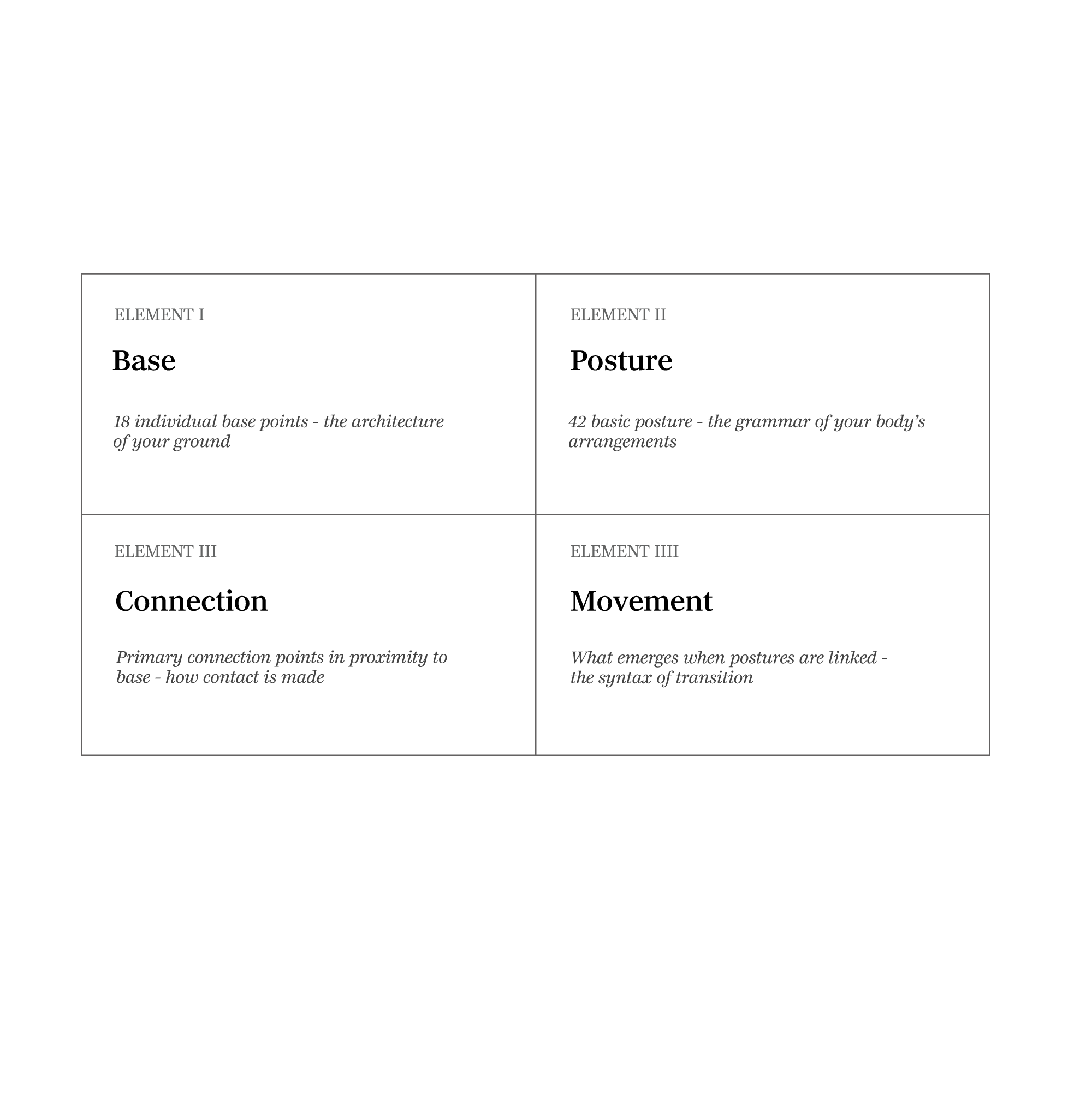
Together—base, posture, connection, and movement—constitute what we call structure. Structure is not a single thing but a whole function. And it is your structure that gives you the right to influence the world between you and your partner.
The world that neither of you own
Here is where most practitioners get lost, and where the art becomes most interesting: the fundamentals operate primarily in relationship. When you step onto the mat with another person, a world is created between the two of you. Neither of you owns it. Both of you can influence it. But whoever brings better structure—whoever has more truly inhabited the fundamentals—earns the right to determine what possibilities are even available there.
This is a profound idea if you sit with it. It means that your work begins long before you encounter another practitioner. You prepare for the relationship by mastering, alone, the components that will make you capable of governing that shared space when it appears. You map your own solar system so that you are ready when you must navigate beyond it.
The fundamentals, in this sense, are not restrictions. They are not a cage of correct form. They are a kind of orientation device—crude but useful, stable reference points inside the infinity of jiu-jitsu’s positional universe. While positions are infinite, the fundamental relationships that govern them are not. They reduce chaos into recognizable zones. They do not perfectly describe reality—nothing does—but they allow you to navigate it without drowning.
When people turn to fundamentals and they do not work immediately, they retreat—into instinct, into habit, into the version of themselves they have always trusted. And so, to return to the analogy, they will never leave their planet.
On the gravity of pressure
Pressure is another word we misuse, and its misuse costs us dearly. Most practitioners reduce pressure to weight, to pain, to discomfort. While necessary—and admittedly fun—that is a crude pressure. It works against the weak and less skilled because it simply overwhelms them physically. But against a skilled oppoent, crude pressure breaks apart like a sandcastle. It has no real architecture to sustain it.
True pressure is something more subtle and powerful. I would describe it this way: pressure is the invisible consequence of well-applied force through structure that constrains your opponent’s options, reducing both their time and clarity of thought. It is not about making things uncomfortable. It is about making good decisions unavailable.
Consider what structural pressure actually does in practice. It breaks your alignment, so your posture cannot support a response. It removes space you need to move, so your frames have nowhere to reorganize. It pins your key base points, so you cannot build structure. And it controls your rotation, so the escape route you can see is not one your body can actually take. Each of these is a decision made unavailable. Notice too, that these four consequences map almost exactly onto the four elements we discussed earlier—without adding a single technique or relying on attributes. This is not a coincidence. Structural pressure is what happens when someone weaponizes their fundamentals against yours. The better structure wins, and the losing structure collapses on itself, option by option, until there is nothing left to do.
Now, one might ask about attributes—about speed, strength, endurance, flexibility. Why not simply rely on those? The answer is philosophical as much as practical. We want to move from inefficient, to efficient, to super-efficient—reducing reliance on attributes so that we are forced to focus on structure, which increases efficiency and lowers effort. Without attributes, pressure emerges from base, alignment, connection, and direction of movement. You are using structure to take space and options. A smaller person can absolutely create this kind of pressure. A well applied armbar, for example, requires no strength to finish against a resisting opponent. This is one of jiu-jitsu’s enduring miracles.
With attributes, the picture changes only in degree, not in kind. Weight increases connection. Strength increases control. Endurance sustains pressure over time. But attributes do not generate pressure—they multiply correct structure. A strong person with bad stucture leaks pressure like a cracked dam. A skilled person with good structure feels heavy without being heavy and can control when and where to apply attributes. This is not metaphor. Anyone who has rolled with a black belt has felt it: a weight that is not weight, a control that seems to appear from the ether, a sense that you are moving through something denser that air.
What is actually happening is that their pressure is compressing your decision-making window while expanding theirs. You become prey—fewer viable options, less time to act, panic. They become the apex predator—more control, more options, more weapons available. The shared world between you is shaped entirely in their favor, not by force, but by the force of superior structure.
On the speed of processing
Processing is a unique component in this system, because it is not what people think it is.
Most people assume it is a knowledge problem—that the practitioner who processes the fastest simply knows the most techniques. And so they set off collecting. They accumulate positions, entries, finishes, counters, searching for the complete picture. I understand the impulse. But this approach quietly assumes that jiu-jitsu is a library, and that the one with the most books wins. It is not. And they do not.
The trouble is that the library is infinite. There is no bottom to it. Chase techniques as your primary pursuit and your game will always feel incomplete—because it is. Something will always be missing. Some positions will always feel unfamiliar. This is not a failure of effort. It is a failure of orientation.
So what is processing, if not the accumulation of technique? would describe it this way: processing is the speed and clarity with which you can perceive, interpret, and act on changes to your partner’s structure. It is not about knowing more. It is about seeing more clearly—and seeing sooner—what is already there.
This is why intimate knowledge of the fundamentals matters so deeply. When your structure is compromised, your processing collapses with it. You cannot see clearly because your body cannot support the action that seeing would require. When you are under pressure, your processing narrows. Options disappear faster than you can name them. What remains feels chaotic, urgent, impossible to organize.
But when your structure is sound and pressure is applied, the opposite occurs. Your processing expands. You begin to see more of what is available—not because you have changed, but because more is actually available to be seen. The fight slows. Possibilities present themselves earlier, and with them a quiet confidence that is easily mistaken for talent. I have told students this many times: after sufficient practice, you already have access to all the jiu-jitsu you need. The base line structure is there. What is missing is the awareness to recognize it in time to use it.
This is why experienced practitioners seem calm in the middle of chaos. It is not that they think faster in any simple sense. It is that their structure and pressure have created a world in which thinking becomes simple. It is that that structure and pressure have created conditions in which thinking becomes less necessary. Processing, like pressure, is not separate from the fundamentals. It is their internal face—what it feels like, from the inside, when structure has put time and possibility on your side.
The mirage of timing
This brings us, finally, to timing—and to one of the most important misunderstanding in all of martial arts instruction. Timing is almost always taught as a moment problem: when do I go? Watch for the window. Feel the opening. Act at the right instant. And so practitioners spend years chasing moments, trying to feel their way into the correct millisecond, wondering whey their timing seems perpetually off.
Here is the thing: if your structure is not correct, the window you see is not real. It is a mirage. Either the window is so small that it collapses before you can move through it, or you move at exactly the right moment but your action has no effect because the techniques has no foundation from which to express itself. It feels like a timing failure. It is actually a structural failure.
Timing is not independent. Timing is downstream. It is the moment that emerges—made real, made usable—by the presence of structure, pressure, and processing. No structure means you cannot transfer force, control distance, or limit your opponent’s counters. No pressure means your opponent retains too many options, and any window that appears disappears before you can act. But when structure is sound and pressure applied, timing becomes almost intuitive. The window is wide—and it stays open.
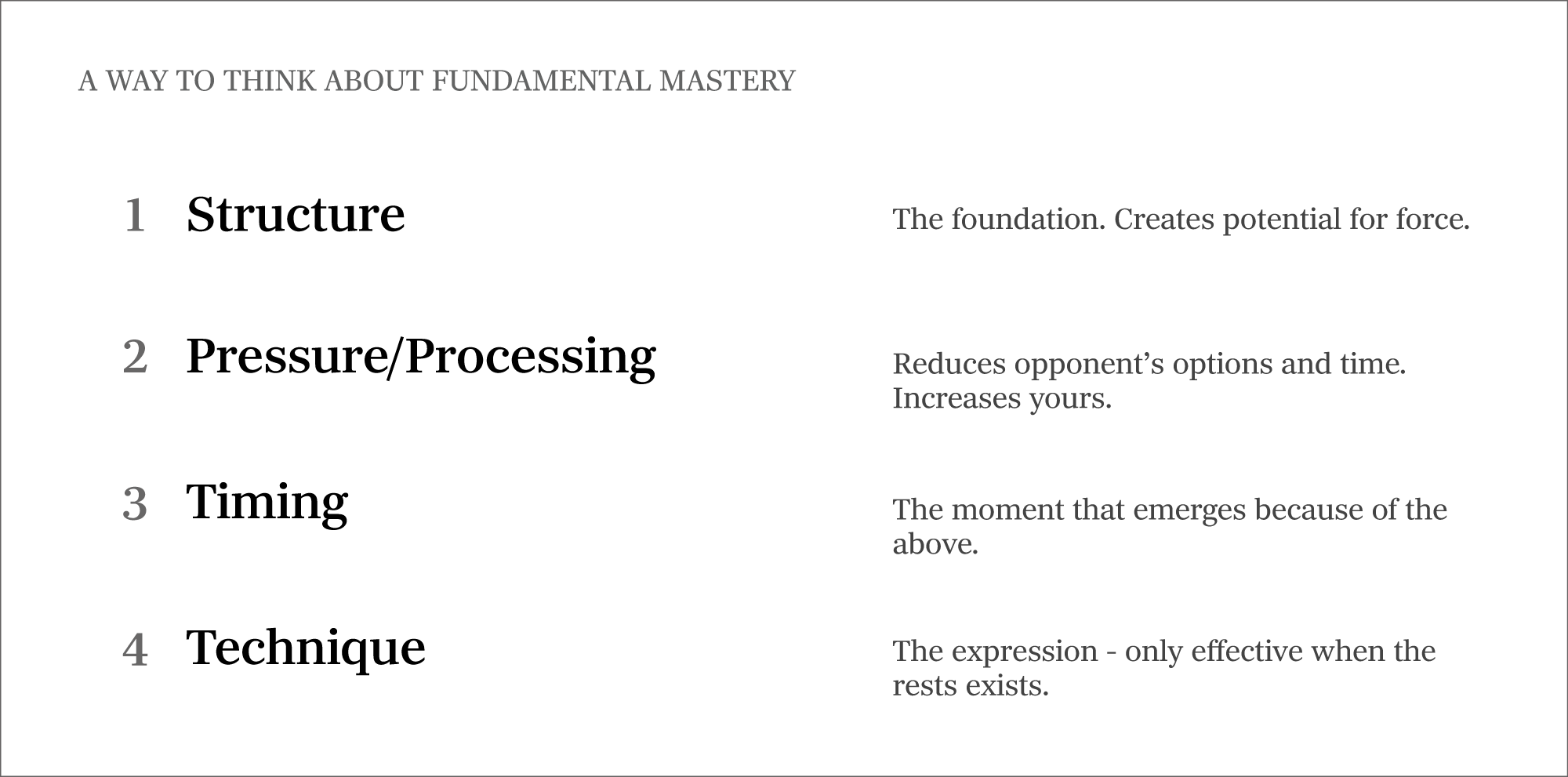
Beginners chase techniques and timing. It is natural—these are the visible things. A sweep is visible. The submission is visible. The timing that sets them up is almost visible through your partner’s positioning. But the structure that makes timing real, the processing that recognizes possibility, and the pressure that opens the window—these are invisible. They happen before the technique begins. They are the cause. The technique is only the effect.
So when you watch someone with exceptional timing—when it seems like they are moving in a different dimension of the same fight, always early, always in position, always one step ahead—what you are often really seeing is good structure, fast procesing, and applied pressure. Their timing looks miraculous because the conditions for timing to exist have been thoroughly prepared. It looks like intutition. It looks like genius. It is neither. It is fundamentals fully inhabited.
I am aware that none of this is fully satisfying—that I have gestured at something enormous and only partially illuminated it. Michel de Montaigne himself wrote that to philosophize is to learn to die, meaning the deepest inquiry brings us face to face with what cannot be fully known. The fundamentals of jiu-jitsu are a little like that. Slightly out of reach for all of us. They exist beneath the surface of the art, generating everything we see, and yet they resist being pinned down into neat definitions. That’s honestly what makes it enjoyable.
What I can say with confidence is this: they are real, they are objective, and they are indifferent to your preferences. They do not care what we think about them or whether we choose to engage with them. They will simply be there, on the mat, in every exchange, every roll, every moment of contact—rewarding those who have done the invisible work, and quietly exposing those who have not.
The mat is a philosopher’s stone in that sense. It does not lie.